

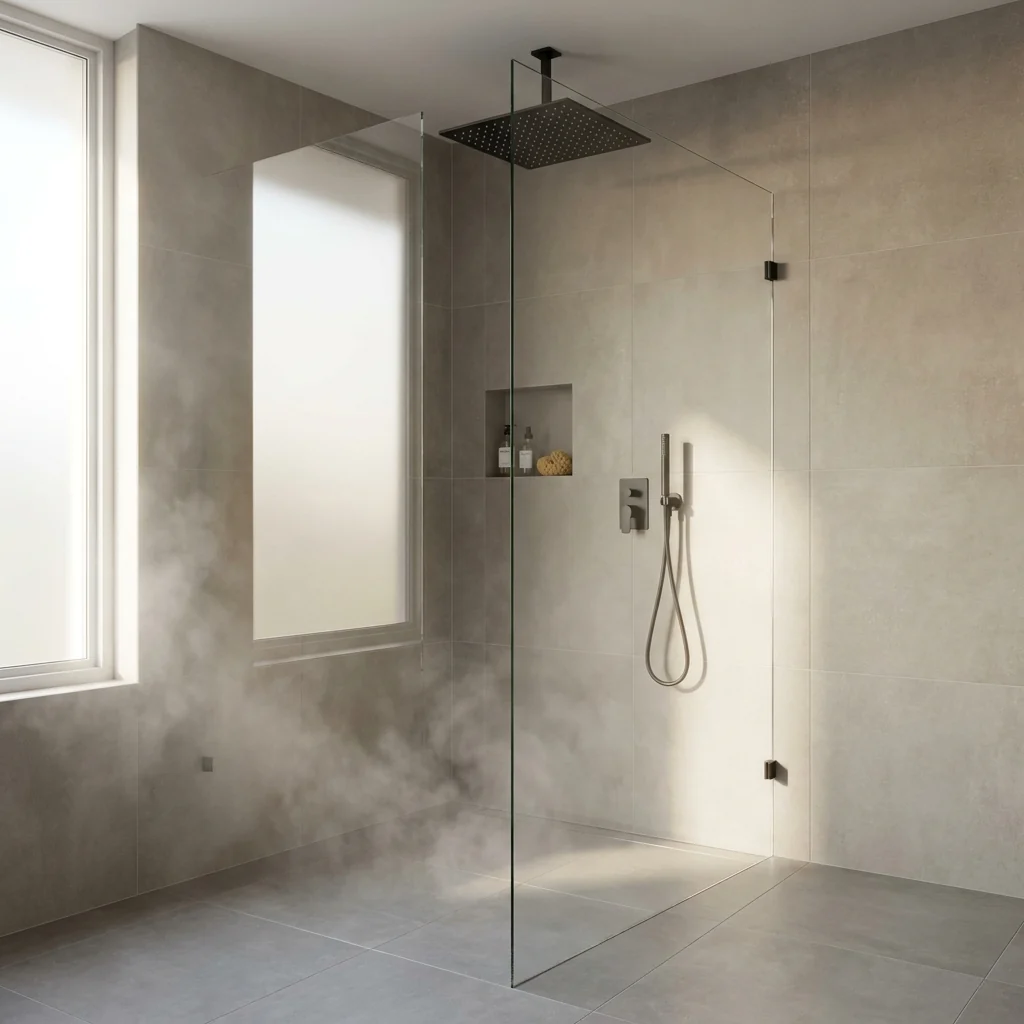
No — not in the wet zone. BS 5385-1:2018, the British code of practice for internal wall tiling, steers specifiers away from gypsum-based backgrounds such as plasterboard in areas subject to repeated or prolonged wetting — and a shower enclosure is the definitive example. Even "moisture-resistant" plasterboard only slows water absorption; it does not change the fact that a gypsum core softens and loses strength when it is wetted again and again.
Outside the shower enclosure — on bathroom walls that see splashes and steam rather than direct, repeated wetting — plasterboard remains an acceptable tiling background within its weight limits. The problem is specifically the wet zone: the walls inside and immediately around the shower, the enclosure of a bath used for showering, and any wall in a wet room. That is where gypsum does not belong behind tile, and where a purpose-made backer board does. This article covers what the standard actually says, why moisture-resistant board is not the answer, and what to install instead.
What BS 5385 Actually Says
BS 5385-1:2018 is the code of practice for the design and installation of internal ceramic, natural stone and mosaic wall tiling. Two of its provisions matter here.
First: background suitability. The standard distinguishes between dry areas, areas subject to occasional wetting, and areas subject to frequent or prolonged wetting. For that last category — showers, wet rooms, commercial washdown areas — it discourages gypsum-based backgrounds. Gypsum absorbs moisture readily and is structurally degraded by repeated wetting cycles, so the standard treats it as unsuitable where recurring wetting is part of normal service.
Second: tiling weight. BS 5385-1 limits the weight of tile plus adhesive that gypsum plasterboard can carry when tiled directly to a maximum of 32 kg per square metre. That is adequate for lighter ceramic, but it constrains the large-format porcelain and natural stone now specified as standard in bathroom design. A rigid tile backer board carries substantially more.
In short, the standard does not merely prefer purpose-made backer boards in showers — it points away from plasterboard in exactly the areas people most often want to tile over it.
Why Moisture-Resistant Plasterboard Still Fails
Moisture-resistant plasterboard — the green board familiar from bathroom refits — is ordinary gypsum board with water-repellent additives in the core and facing paper. Those additives slow the rate at which the board takes on moisture. They do not make it waterproof, and they do not change what happens once water reaches the gypsum.
And in a shower, water eventually reaches the gypsum. A tiled surface is not a sealed surface: grout is water-resistant rather than waterproof, joints and screw penetrations create pathways, and steam drives water vapour into the wall build-up with every use. Repeated wetting cycles soften and swell the gypsum core, the adhesive loses its grip, and the first visible symptoms — hollow-sounding tiles, cracked grout lines, a spongy wall — usually appear long after the damage behind the tiles has spread.
Tanking the plasterboard with a liquid or sheet membrane before tiling improves the odds, and is the minimum sensible precaution if plasterboard is used anywhere near a wet area. But a tanking membrane over gypsum is protecting a substrate that cannot tolerate a single breach. One missed corner, one screw through the membrane, one hairline movement crack — and the board behind it begins to fail. A wet-area substrate should not depend entirely on the perfection of a coating.
What to Use Instead
Guidance from The Tile Association recognises two board families as suitable for all wet applications, including showers and wet rooms: cement-based boards, and foam-cored building boards — panels with an extruded polystyrene (XPS) core faced on both sides with a cementitious, fibreglass-reinforced coating.
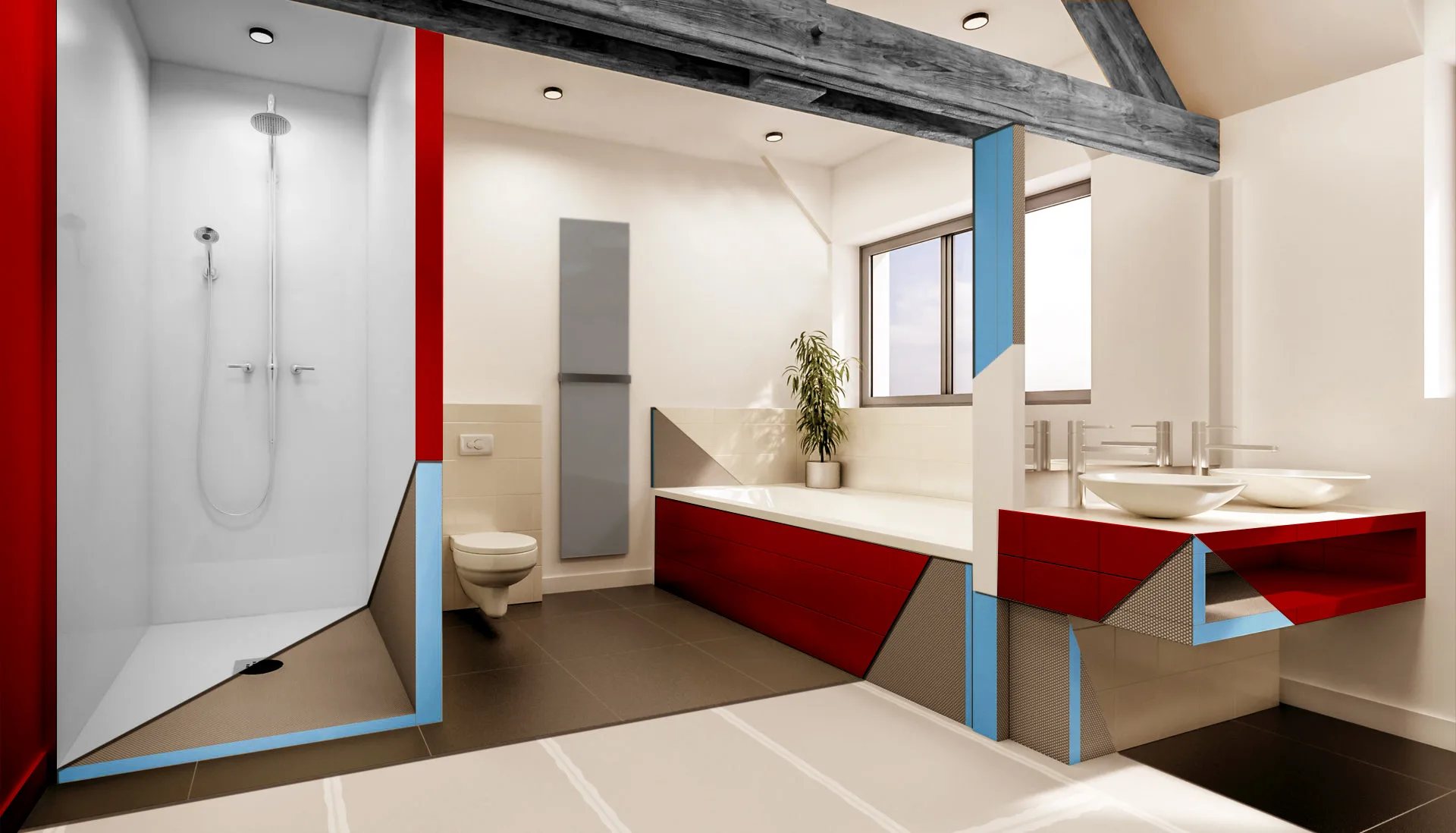
Insutile® Build Board is the second type. Its closed-cell XPS core has water absorption of 0.1 percent or less by volume: water cannot wick through it because every cell is sealed. The board body is therefore not damaged by water. The joints between boards, the fixing points and any pipe penetrations are sealed with the system tape, washers and sealant, and in most showers a waterproofing membrane is applied over the boarded surface before tiling. For a detailed look at how the two wet-area board families compare, see our XPS vs cement board guide.
Just as importantly for anyone used to working with plasterboard: the workflow is the same, only lighter. Build Board scores and snaps with a utility knife, fixes to studs or masonry with screws and washers, and weighs a fraction of an equivalent cement board — so a plasterboard-competent installer needs no new skills. The board is a drop-in replacement for plasterboard in the wet zone. Our installation guides walk through the full sequence.
Plasterboard vs XPS Backer Board at a Glance
| Criterion | Plasterboard (incl. moisture-resistant) | XPS tile backer board |
|---|---|---|
| Waterproof core | No — gypsum softens and swells with repeated wetting | Yes — closed-cell XPS, water absorption ≤0.1% by volume |
| Tiling weight | Maximum 32 kg/m² tiled directly (BS 5385-1) | Substantially higher — suits large-format porcelain and natural stone |
| Tanking needed | Full tanking essential anywhere near a wet zone | Board body is waterproof — seal joints, fixings and penetrations; a membrane is applied in most showers |
| Insulation | Negligible | Thermal conductivity as low as 0.034 W/mK |
| Weight on site | Roughly double the equivalent XPS board — heavier still once damp | Around 3 kg per 1200 × 600 mm board at 12.5 mm — one-person handling |
How to Upgrade an Existing Plasterboard Bathroom
If your bathroom is already lined with plasterboard, the upgrade path depends on the zone:
- Inside the wet zone — strip the plasterboard back to the studs or masonry and replace it like-for-like with Build Board. Do not simply overboard wet-zone plasterboard: trapping a gypsum board inside a shower build-up leaves a degradable material in the one place it cannot be inspected or repaired.
- Outside the wet zone — sound, dry plasterboard on the room's remaining walls can stay, or be overboarded with a thin Insutile® board where you want a waterproof, insulating tile bed without a strip-out.
- Going full wet room — if the renovation removes the shower tray altogether, the same system extends to the floor: boards, sealed joints, a waterproofing membrane and a pre-sloped shower base.
The complete wet-zone build-up — board, joint tape, washers, sealant, waterproofing membrane and shower base — is designed as a single system. Our bathroom solutions overview shows how the components fit together, and the technical team will spec the build-up for a specific project on request.
Frequently Asked Questions
Can I tile over moisture-resistant (green) plasterboard in a shower?
It is not recommended. Moisture-resistant plasterboard slows water absorption but its core is still gypsum, which degrades with repeated wetting. In the wet zone of a shower, use a board designed for wet areas — a foam-cored XPS backer board or a cement board — rather than relying on a tanking membrane to protect a moisture-sensitive substrate.
Do I need to tank XPS backer board in a shower?
In most showers, yes. The closed-cell XPS core is inherently waterproof, so the board is not damaged by water, but a waterproofing membrane is still applied over the boards in most shower build-ups. The joints between boards, the screw fixing points and any penetrations for pipes or valves are sealed with the system's sealing tape, washers and sealant. Some build-ups do not need a membrane, so confirm it against the specification.
How much tile weight can plasterboard hold?
BS 5385-1 limits direct tiling onto gypsum plasterboard to a maximum of 32 kg per square metre of tile plus adhesive. Large-format porcelain and natural stone can approach or exceed this. XPS tile backer boards carry substantially more, which is one reason they are the default substrate for heavy, large-format wall tiling.
What is the best board to tile onto in a shower?
The Tile Association recognises cement-based boards and foam-cored building boards (XPS core with cementitious faces) as suitable for all wet applications. Of the two, XPS boards add a waterproof core, one-person handling weight and genuine thermal insulation — which is why they have become the standard specification for residential showers and wet rooms.
Replacing plasterboard in a shower or planning a full wet-room build? Explore Insutile® Build Board, request a sample pack from the contact page, or talk to our technical team for a project-specific specification.