In Cairo, Alexandria, Riyadh, and Dubai, summer is a full third of the year. Peak temperatures routinely exceed 40°C, air conditioning runs from breakfast to bedtime, and energy bills reflect every degree of difference between the inside of a building and the furnace outside. For homeowners and developers across the MENA region, thermal performance is not a nice-to-have specification detail — it is a month-over-month operating expense.
Most conversations about building efficiency focus on obvious places: exterior walls, rooftops, window glazing. But there is a surface area in every building that is almost always overlooked and frequently costs far more than it should — the tiled floors and walls of bathrooms, kitchens, and wet rooms.
This is where XPS tile backer boards quietly do something that other substrates simply cannot: they deliver real, measurable thermal insulation in the same installation that delivers waterproofing. One board. Two problems solved. The economics of this double-duty are particularly powerful in hot climates, and the case is worth examining closely.
Why Tiled Surfaces Are a Thermal Weak Point
Tile is a wonderful finish material. It is durable, easy to clean, waterproof at the surface, and beautiful when installed well. What it is not is a thermal insulator. Ceramic, porcelain, and stone tiles all conduct heat efficiently — that is physics, not a manufacturing flaw.
Which means the temperature on the far side of a tile tells you almost exactly what the wall or floor behind the tile is doing. If the substrate is unsulated, the tile surface reflects that reality. In a hot climate, that means cold air-conditioned rooms leak cool air through the floors and walls constantly, pulling warm heat in from the surrounding structure. In a cool climate, the reverse happens.
Traditional cement backer boards do nothing to fix this. They are themselves thermally conductive, so the tile and the substrate behave as a single heat-conducting assembly. Every square metre of tiled floor in a bathroom is a square metre of thermal weakness — and in a country where cooling is the dominant energy load, that adds up fast.
The XPS Difference: Thermal Conductivity of 0.034 W/mK
Extruded polystyrene — XPS — is a closed-cell insulation material that has been the default choice in construction thermal applications for decades. Its closed-cell structure traps air in millions of tiny pockets, giving it exceptional resistance to heat transfer.
Insutile XPS tile backer boards achieve a thermal conductivity as low as 0.034 W/mK — and in the thicker board specifications (20, 30 and 50 mm) the substrate becomes a meaningful insulation layer in its own right. For context, that places the material squarely in the same performance bracket as dedicated rigid insulation boards specified for exterior wall systems. The board is not a substrate with some insulation properties. It is an insulation material with a substrate facing.
Translated into real-world terms, a bathroom wall built up with Insutile XPS boards has dramatically lower heat transfer through its surface than the same wall built up with cement backer board. The air-conditioned room holds its cool air longer. The cooling system cycles less frequently. The monthly electricity bill drops accordingly.
The benefit is at its strongest in two specific scenarios that are common in the MENA region:
- Ground-floor bathrooms where the floor slab sits directly on warm earth or an unconditioned space below. Heat transfer through a tiled floor into that space is continuous and significant. An XPS-backed floor breaks the thermal bridge.
- Upper-floor bathrooms with external walls where direct solar gain on the building facade conducts through to interior tiled surfaces. Insulation at the substrate layer blocks that heat transfer at exactly the point where it would enter the conditioned room.
Breaking the Thermal Bridge
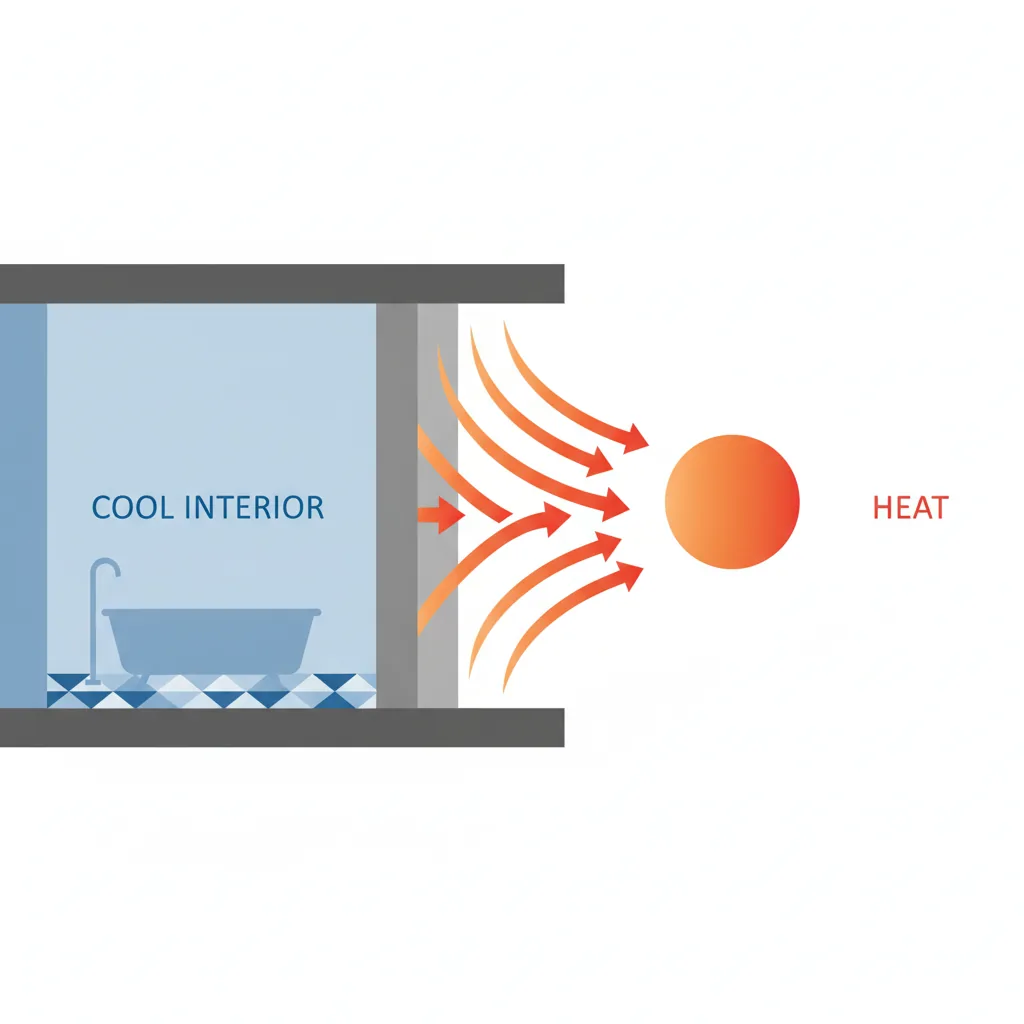
The single biggest architectural concept to understand in energy-efficient design is the thermal bridge — any point in a building envelope where heat can transfer easily between the inside and outside. Thermal bridges are expensive because heat always takes the path of least resistance, so the performance of an entire wall can be undermined by a single bridge running through it.
Bathrooms are notorious for creating thermal bridges. Structural elements run through wet areas. Plumbing penetrations pierce walls. Tiled finishes conduct heat. Traditional backer boards compound the problem by providing no thermal break between the finish layer and the structural layer.
Insutile XPS boards break this chain at the most vulnerable point. By interposing a continuous layer of closed-cell insulation between the tile and the structure, the board interrupts the thermal bridge across the entire wet area. The effect is particularly pronounced in wall-mounted installations around window reveals, shower enclosures on external walls, and any area where the structural wall is exposed to direct solar gain.
Underfloor Heating's Perfect Partner
Underfloor heating is increasingly popular in the region — not just for winter warmth but for the comfort of a slightly warmed floor during cooler months and the luxury appeal in premium residential projects. Yet underfloor heating systems only deliver their efficiency potential when they sit on a properly insulated substrate.
The reason is straightforward. Heat emitted by an underfloor heating element will travel in whatever direction encounters the least thermal resistance. If the floor below the element is uninsulated, a significant portion of that heat is lost downward into the slab — energy paid for and wasted.
XPS boards placed beneath or around underfloor heating act as a thermal reflector. The closed-cell core forces heat upward into the room where it is needed. Systems installed on XPS substrates typically reach target temperature faster, hold temperature longer after the element cycles off, and consume measurably less electricity to maintain comfort.
For a homeowner commissioning a premium bathroom or kitchen with underfloor heating, specifying XPS boards is one of the highest-return decisions in the build. For a developer delivering a premium residential project, it is a selling point that translates directly into tenant satisfaction and lower building operating costs.
A+ Energy Performance, Verified
Thermal claims in construction materials are sometimes aspirational. Insutile's thermal performance claims are not. The product line carries CE marking, BBA certification, and ISO 9001 quality assurance. Thermal conductivity figures are verified in independent testing. The A+ energy performance classification is documented, not marketing.
For specifiers working to regional green building standards — whether Egypt's Green Pyramid Rating System, Saudi Arabia's Mostadam certification, or Dubai's Al Sa'fat — a certified thermal insulation substrate simplifies compliance documentation considerably.
The Economic Case in a Hot Climate
Bringing the individual elements together, here is the shape of the economic argument:
- Cooling load in a MENA-region home dominates the annual energy bill, often accounting for 60 to 70 percent of electricity consumption.
- Wet areas with tiled finishes represent a significant percentage of the interior surface area in most homes.
- Traditional tile substrates provide effectively zero thermal resistance, making those surfaces continuous conduits for unwanted heat gain.
- Replacing or specifying XPS in those same areas delivers meaningful thermal break performance at no extra installation step.
The payback period is short. The ongoing saving compounds over every year of occupancy. And because the waterproofing benefit is delivered in the same board, the specification is net-cheaper than using a cement backer plus separately installed insulation to achieve comparable performance.
Quieter, Drier, Cooler
There is one final benefit worth mentioning for regional buyers. Closed-cell XPS has useful acoustic properties alongside its thermal ones. In apartment buildings where sound transmission between units can be a significant complaint, XPS-backed wet areas are noticeably quieter than cement-backed equivalents. The footfall of the upstairs neighbour, the running shower in the adjoining unit — the board dampens both.
Combined with the waterproofing, the insulation, and the installation speed, that makes XPS tile backer boards one of the most multi-purpose upgrades available to anyone building, renovating, or specifying in the region.
Specifying for Performance
If you are planning a project in a hot-climate region, the substrate decision is not a throwaway detail. It is one of the highest-leverage choices in the entire specification — affecting cooling costs, comfort, longevity, and compliance for the entire life of the building.
Insutile offers a full system engineered for exactly these conditions, with technical support available for projects of any scale. Whether the requirement is a single premium bathroom or a full high-rise residential tower, the specification starts with the board behind the tile.
Explore the full Insutile system and request thermal specification documentation at insutile.com. Our technical team supports specifiers across Egypt, the GCC, and the wider MENA region.