

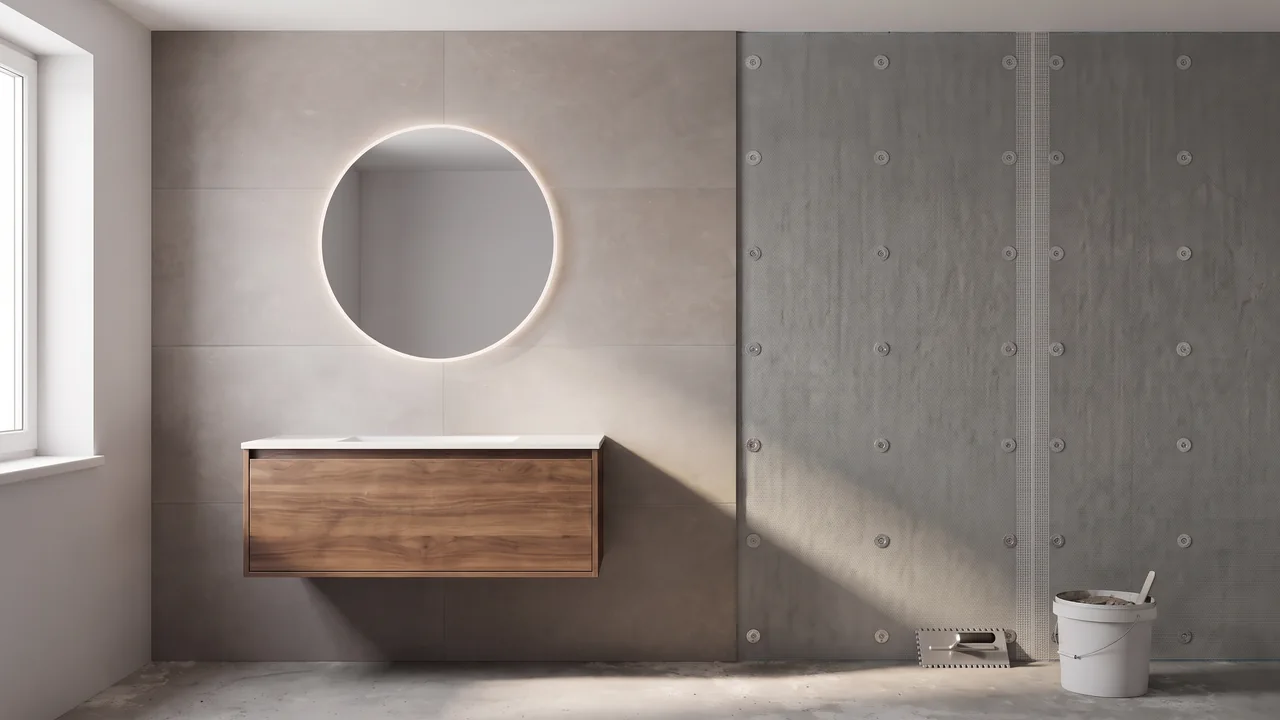
The short answer: for bathroom walls that get wet, an XPS tile backer board is the best option, because it is the only common substrate that is waterproof through its thickness, light enough to fit single-handed and ready to tile without priming. Cement board is the traditional alternative and is still a sound choice where impact resistance matters most. Moisture-resistant plasterboard is adequate for dry areas only, standard plasterboard should not be tiled in a bathroom at all, and tiling direct to masonry works only when the wall is flat, dry and sound.
Below, each option is compared on the five things that decide whether a tiled bathroom wall lasts: how it handles water, how much it weighs, how much tile it can carry, whether it insulates, and what it takes to install. For the shower enclosure specifically, see tile backer board for showers.
What are the five options?
- XPS tile backer board. A closed-cell extruded polystyrene core faced both sides with mesh-reinforced cementitious mortar. Insutile® Build Board is this type.
- Cement-fibre board. Portland cement reinforced with fibres, pressed into a dense sheet.
- Moisture-resistant plasterboard. Gypsum board with water-repellent additives, usually green-faced.
- Standard plasterboard. Ordinary gypsum board behind a paper face.
- Direct to masonry or plaster. No board; the tiles are bonded to the wall itself.
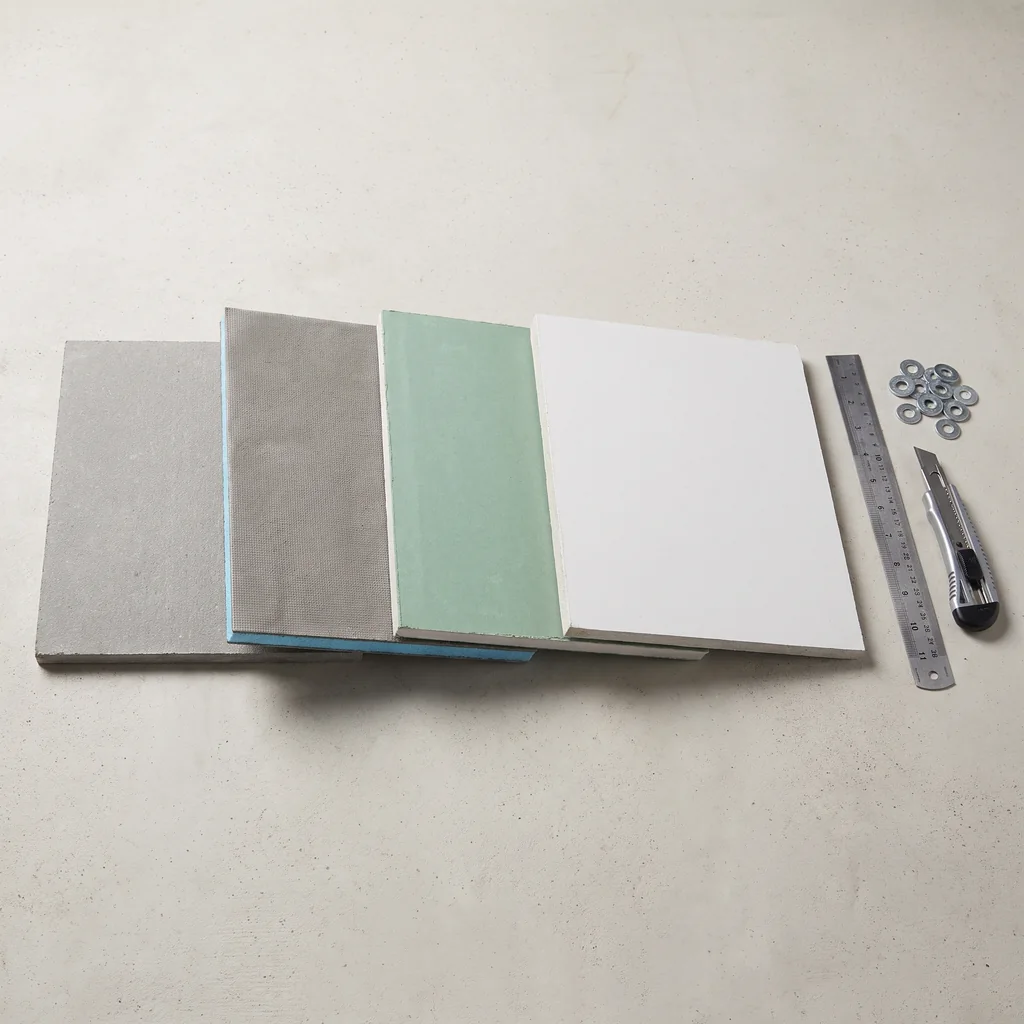
How do they compare?
| Criterion | XPS tile backer board | Cement-fibre board | MR plasterboard | Standard plasterboard | Direct to masonry |
|---|---|---|---|---|---|
| Waterproof through the body | Yes (≤ 0.1 % absorption, EN 12087) | No — water-resistant, absorbs water | No — needs tanking in wet areas | No | No — masonry absorbs |
| Weight, 600 × 1200 × 12.5 mm | About 3 kg | About 22 kg | About 8 kg | About 7 kg | n/a |
| Tile load | Porcelain and stone with C2 adhesive | Porcelain and stone | 32 kg/m² limit (BS 5385) | 32 kg/m² limit | 20 kg/m² on plaster |
| Insulation | λ 0.034 W/mK | None | Negligible | Negligible | None |
| Cutting | Score and snap, no dust | Saw or score; dusty | Score and snap | Score and snap | n/a |
| Priming before tiling | None | Usually required | Required | Required | Usually required |
Which option handles water best?
Only the XPS board is waterproof in its own right. Cement board resists water but is porous; it will not rot, but it holds moisture and passes it through to whatever is behind. Both kinds of plasterboard depend entirely on a membrane applied over them, which is why BS 5385 requires tanking before plasterboard is tiled in a shower. Masonry absorbs water and, in an older building, can carry it to the other side of the wall.
For a wall that is splashed occasionally, any of the first three will do. For a wall that is wet every day, plasterboard depends entirely on its membrane: if the membrane fails, the core takes up water. An XPS board does not absorb water behind a failed joint. In showers, a waterproofing membrane is applied over the boards and joints in most cases. The plasterboard and showers article goes through the standard in detail.
Which is easiest to install?
Weight decides this. A 600 × 1200 mm XPS board at 12.5 mm weighs about 3 kg; the equivalent cement board is around 22 kg and has to be cut with a saw. One person can carry, cut and fix XPS boards all day, in an occupied house, up a staircase, without dust. That is the reason renovators moved to XPS first, and it is quantified in how XPS boards cut installation time.
Plasterboard is also easy to handle, but it has to be fully tanked before tiling wherever it will get wet. Direct-to-masonry needs the wall to be flat to within a few millimetres, which in practice means plastering or dubbing out first.
Which carries heavy porcelain and stone?
XPS and cement boards both carry large-format porcelain and natural stone with a standard C2 adhesive. The limit on an XPS board is the fixing into the studs or wall, not the board face, which is why Insutile® boards are fixed through wide-head washers at 300 mm centres. Plasterboard is limited by the standard to 32 kg/m² including adhesive, and plaster to 20 kg/m², which rules out most stone and many 10 mm porcelains.
Does the substrate affect the room's insulation?
Only the XPS board insulates. Its core has a thermal conductivity of 0.034 W/mK, so even a 12.5 mm board takes the chill off a tiled wall, and a 20 to 50 mm board turns an external bathroom wall into an insulated one. That matters for condensation as much as for comfort: a warmer tile surface collects less moisture. This article on thermal performance covers the figures.
When is cement board still the right choice?
Where the wall will take hard knocks, in a commercial kitchen, a plant room or a heavily used public washroom, the density of cement board gives it an edge in impact resistance. Everywhere else, the weight, dust and lack of insulation count against it. The two materials are compared in full in XPS vs cement tile backer boards.
What does Insutile® offer for bathroom walls?
Build Board is produced from 4 to 80 mm in 600 × 1200 and 600 × 2400 mm panels, with other sizes and thicknesses to order. It is used with Angle Board for corners and pipe boxing, Trays and Niches for recesses, and the fixing and sealing accessories. The way these combine in a complete room is shown on the bathroom solutions page, and the board calculator gives quantities for a wall area with openings subtracted.
Frequently Asked Questions
What is the best tile backer board for a bathroom wall?
For walls that get wet, an XPS tile backer board such as Insutile® Build Board: it is waterproof through its thickness, weighs about 3 kg per 600 × 1200 mm sheet, takes standard tile adhesive without priming and insulates the wall at the same time. Cement board is the alternative where very high impact resistance is the only priority.
Is moisture-resistant plasterboard good enough for a bathroom?
For a dry-area bathroom wall, yes. Behind a shower or bath it must be tanked with a membrane system first, and BS 5385 limits the tile weight it can carry. If the wall will be wet daily, a board with a waterproof core is the safer specification, because it does not take up water if the membrane is breached.
Can I tile straight onto a masonry or plastered wall?
On a sound, flat, dry masonry wall, yes, with a suitable primer. On plaster, the tile weight limit is 20 kg/m², which rules out most porcelain. Boarding over the wall with a thin XPS board gives a flat, waterproof face and removes the weight limit question.
How much weight can a tile backer board carry?
Insutile® Build Board carries porcelain and natural stone with standard C2 adhesives; the limit in practice is set by the fixing into the wall or studs, not by the board face. Plasterboard, by comparison, is limited to 32 kg/m² of tile and adhesive under BS 5385.