

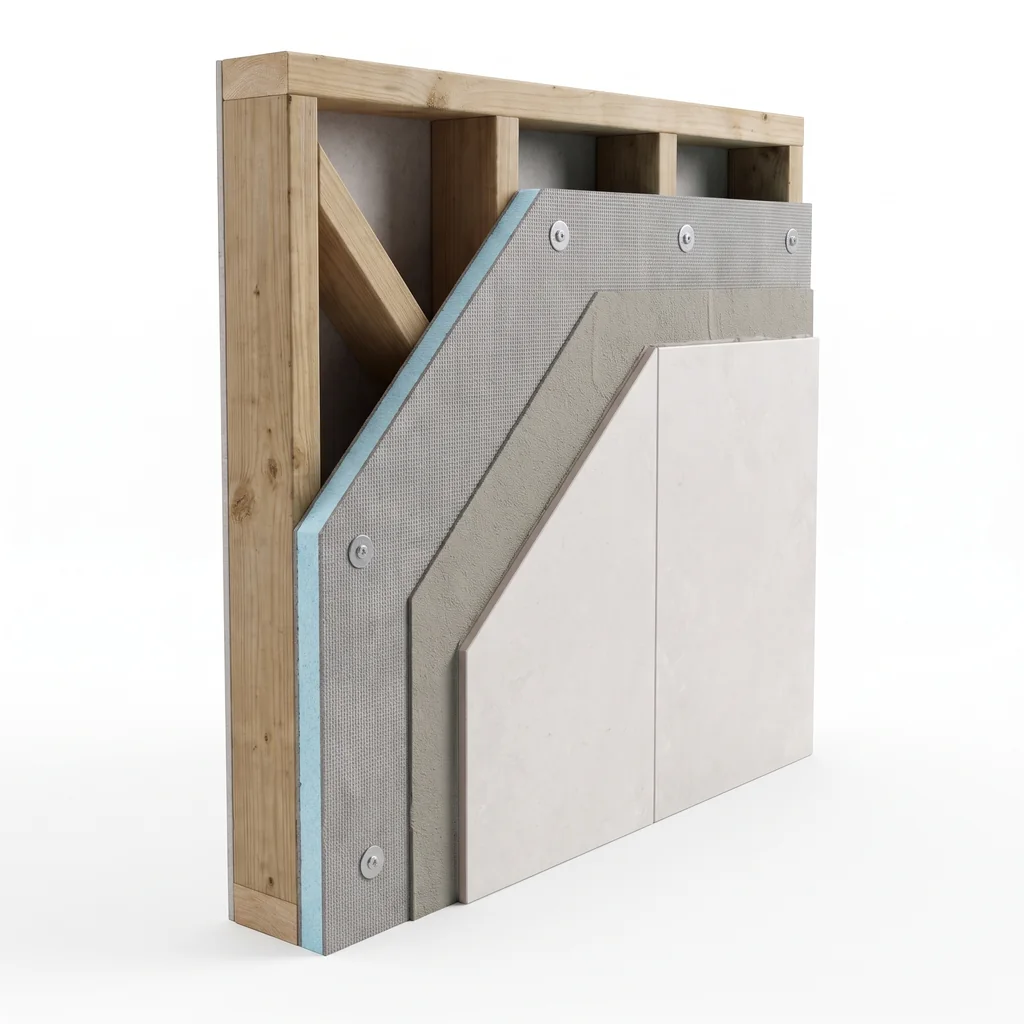
The short answer: a backer board gives tiles a flat, rigid, dimensionally stable and, with the right board, waterproof surface to bond to, so that the tiled finish does not crack, debond or let water into the structure behind it. Tiles and grout are a hard, decorative skin. They cannot hold themselves up, they move with whatever they are stuck to, and they let a small amount of water through. The backer board is the layer that deals with all three.
This article explains each of those jobs, when a backer board is required rather than optional, and what an XPS board such as Insutile® Build Board adds beyond the basic function. If you already know you need one and are choosing between types, see the best tile backer board options for bathroom walls.
What does a backer board actually do?
It gives the tiles a flat surface
Tile adhesive is applied in a thin bed, typically 3 to 6 mm. It cannot correct a wall that is out by 10 mm. A backer board fixed over studs or over an uneven wall gives a true plane, so the tiles lie flat and the grout lines stay even. On a floor the same board levels boards and takes out the ridges between them.
It gives them a rigid surface
Grout and tile adhesive are brittle. If the substrate flexes, by as little as a few millimetres between studs or joists, the grout cracks first and the tiles debond later. A backer board of the right thickness spans between the fixings without flexing. On studs at 600 mm centres, that means 12.5 mm; the thickness guide gives the figures for other situations.
It keeps water out of the structure
Grout is not waterproof. In a shower, water reaches the substrate every day. If that substrate is plasterboard, it softens and the tiles come away; if it is timber, it rots. A waterproof backer board stops the water at the board face. Insutile® boards have a closed-cell XPS core with a water absorption of 0.1 % or less (EN 12087), so nothing behind the tiles can take up water.
It stays the same size
Timber swells and shrinks with humidity; plaster moves as it dries. A stable board between those materials and the tiles decouples the finish from the movement, which is the reason boards are used over timber floors, as described in can you tile directly onto wooden floorboards.
It gives the adhesive something to grip
Tile adhesive needs a surface it can bond to chemically and mechanically. The cementitious, mesh-reinforced face of an Insutile® board is that surface, and it takes any standard C2 adhesive without a primer.
When is a backer board required, and when is it optional?
| Situation | Backer board? | Why |
|---|---|---|
| Shower walls and floors, wet rooms | Required | Daily wetting; plasterboard and timber fail without it, and BS 5385 restricts tiling on plasterboard in wet areas |
| Stud walls anywhere | Required | Plasterboard is limited to 32 kg/m² of tile and adhesive |
| Timber floors | Required | Levels the floor and decouples the tiles from movement in the boards |
| Underfloor heating | Recommended | An insulating board sends the heat up into the tiles rather than down into the slab |
| Kitchen splashbacks and dry-area walls | Recommended | Flat, stable surface; protects the wall from steam and splashes |
| Sound, flat, dry masonry in a dry area | Optional | Tiles can be bonded directly with a primer, within the 20 kg/m² limit on plaster |
Why use an XPS backer board rather than a cement one?
Both kinds give the flat, rigid, stable surface. The difference is in the other jobs. Cement board resists water but absorbs it; an XPS board is waterproof through its thickness. Cement board weighs around 22 kg per 600 × 1200 mm sheet at 12.5 mm; the same XPS board weighs about 3 kg and is cut with a knife. And cement board has no insulation value, where an XPS core has a thermal conductivity of 0.034 W/mK, so the backer board also becomes the insulation layer, which is why it is used under underfloor heating and on cold external walls. The full comparison is in XPS vs cement tile backer boards.
What else can a backer board be used for?
Because an XPS board is rigid, light and tile-ready on both faces, it is used to build the things that are tiled as well as to line them. Insutile® Flex Board bends to a 200 mm radius for curved walls and columns; Angle Board is folded at the factory to 90° for corners and pipe boxing; Shower Underlay is a pre-sloped shower floor; Trays and Niches are one-piece recesses and seats; and Easy Board is the same core with a porcelain tile already bonded to it, for roofs and terraces. The room-by-room combinations are on the solutions pages.
How is a backer board fixed?
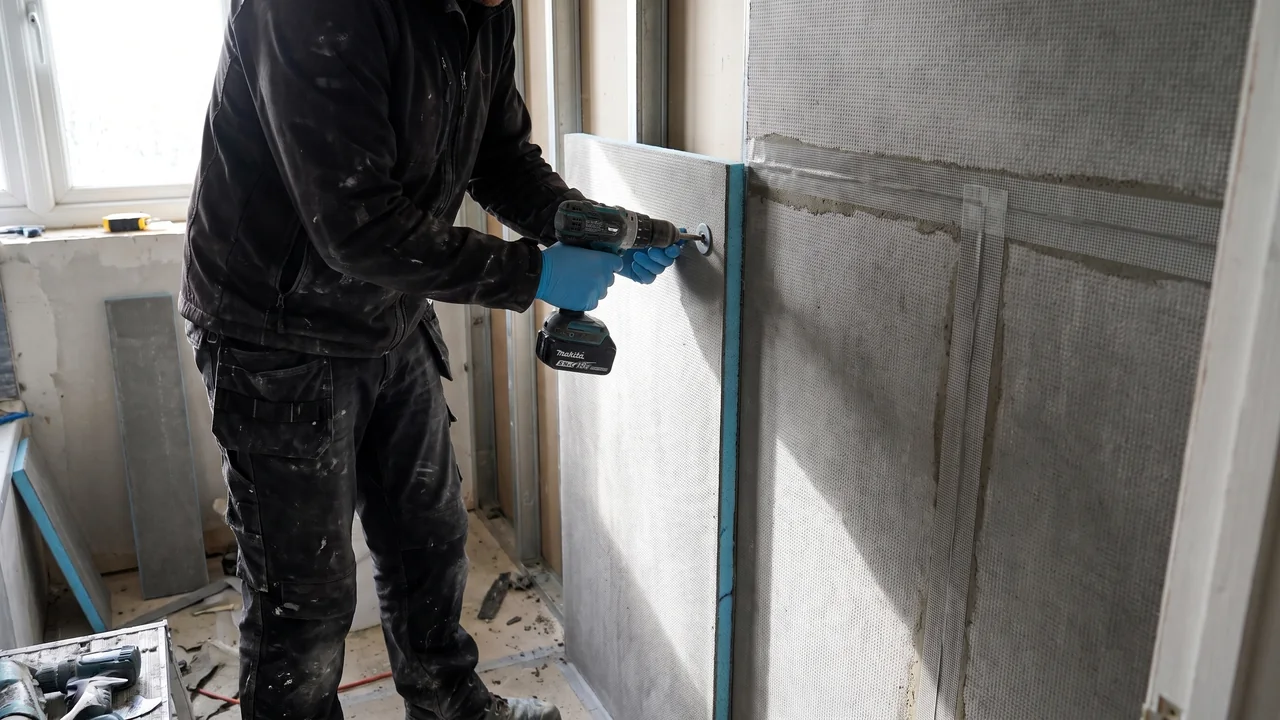
Mechanically, through wide-head washers at 300 mm centres into studs, joists or masonry, or bonded with adhesive and secured with washers on solid walls. Joints are taped with mesh tape, and in wet areas with waterproof sealing tape and corner seals from the accessories range. In showers, a waterproofing membrane is applied over the boards and joints in most cases. Fixing washers are supplied with every Insutile® board. The full method is in how to install Insutile® Build Board, and the installation guides for each product are in the technical library.
Frequently Asked Questions
Is backer board necessary for tiling?
Wherever the existing surface is not flat, rigid and dry, or wherever the area will get wet, yes. In a shower or wet room it is the standard approach; on a sound, dry, flat masonry wall in a dry area it can be omitted.
What is the difference between backer board and plasterboard?
Plasterboard is a gypsum lining for painting; it is damaged by water and limited to 32 kg/m² of tile. A tile backer board is made to carry tile and to resist water. XPS backer boards go further: they are waterproof through the body and insulate.
Does backer board replace waterproofing?
The XPS core has a water absorption of 0.1 % or less, but the board is not the whole waterproofing system. Joints, corners, fixings and penetrations are sealed with tape, corner seals and sealant, and in showers a waterproofing membrane is applied over the boards and joints in most cases.
Can backer board be used on floors?
Yes. On a floor it stiffens and levels the substrate, decouples the tiles from movement in timber floors, and adds insulation under underfloor heating. Thinner boards, 6 to 12.5 mm, are typical on floors.